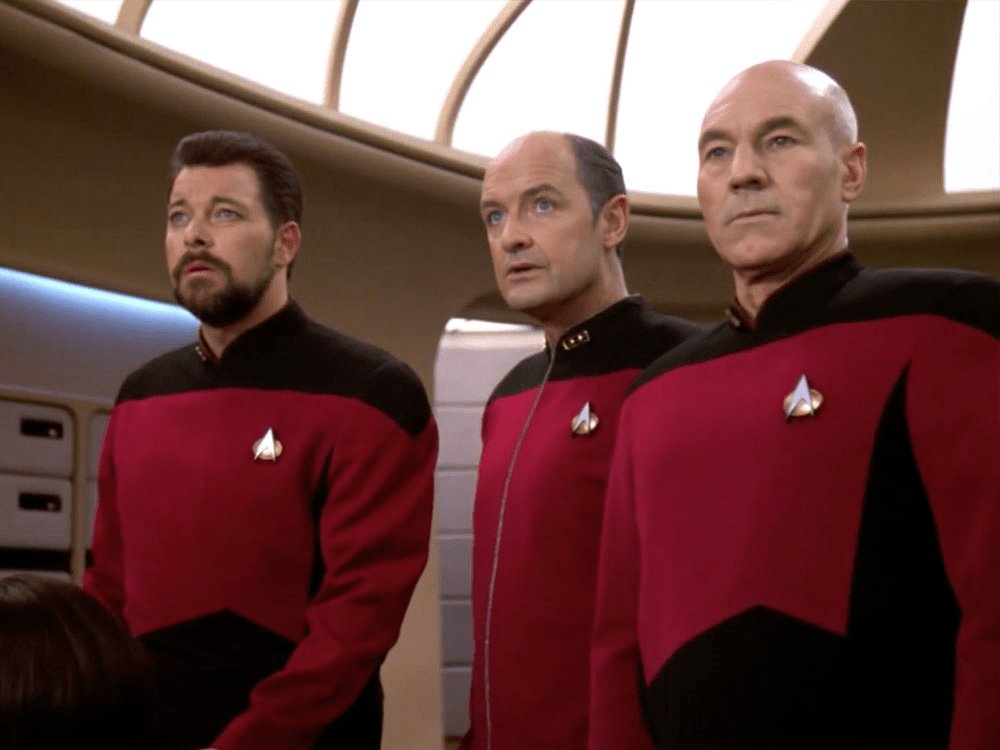
Star Trek TNG Season 7 All Good Things Ending Explained Major Spoilers
Captain Jean-Luc Picard isn't just having a bad day; he's unstuck in time, inexplicably jumping between his past, present, and a grim future, plagued by a mysterious illness and the mischievous presence of Q. If you've ever wondered about the profound implications of this mind-bending farewell, you're in the right place. Dive in as we break down the Star Trek TNG Season 7 Ending Explained & Major Spoilers from "All Good Things...", arguably one of the greatest series finales in television history.
At a Glance: What You Need to Know About "All Good Things..."
- The Premise: Captain Picard finds himself involuntarily shifting between three distinct timelines: seven years in the past (before Enterprise-D's maiden voyage), the present day of the series, and a future over two decades later.
- The Cause: Q, the omnipotent trickster, orchestrated these jumps as humanity's final test, challenging Picard to solve a cosmic puzzle.
- The Threat: A growing "anti-time rift" appears in all three timelines, expanding backward through history and threatening to prevent the very formation of life on Earth billions of years ago.
- Picard's Challenge: He must understand this anomaly across all three time periods, working with different versions of his crew, to avert the annihilation of humanity.
- The Twist: Picard's initial attempts to scan the anomaly actually sustained it. The solution required all three Enterprise ships to fly into the rift simultaneously.
- The Sacrifice: The future Enterprise-D is destroyed in the process of closing the rift.
- Q's Verdict: Humanity passes the test, demonstrating its potential for continued evolution. Q departs, his final lesson delivered.
- The Resolution: The timelines are restored, Picard's future illness (Irumodic Syndrome) is seemingly averted, and the series concludes with Picard joining his senior staff for their regular poker game—a significant moment of acceptance and camaraderie.
The Final Frontier: Setting the Stage for an Unforgettable Farewell
Imagine the pressure: concluding seven years of groundbreaking television, a show that redefined science fiction and captivated millions. Star Trek: The Next Generation had to deliver an ending that was not just satisfying, but truly Star Trek—meaning it had to be intellectually stimulating, emotionally resonant, and forward-looking. "All Good Things...", the two-part series finale comprising the 177th and 178th episodes, which first aired on May 23, 1994, rose to that challenge with spectacular success.
The title itself, "All Good Things...", is a poignant nod to Q's famous pronouncement within the episode: "All good things must come to an end." But for TNG, this wasn't just an ending; it was a powerful statement on the show's enduring themes of humanity's potential, the nature of time, and the bonds of friendship. If you're looking for an expansive dive into the entire run of the final season, be sure to check out Your guide to TNG Season 7. But for now, let's zero in on how it all wrapped up.
Picard's Predicament: Three Timelines, One Impossible Test
At the heart of "All Good Things..." is Captain Jean-Luc Picard's harrowing journey through time. Unlike a simple flashback or flash-forward, Picard's consciousness is literally being yanked across three distinct periods:
- Seven Years Past (Pre-Stardate 47988): This is the era just before the Enterprise-D's very first mission, echoing the pilot episode "Encounter at Farpoint." Here, the crew is barely acquainted, Worf is still serving on the bridge as a security officer (not tactical), and Dr. Crusher, Data, and Geordi are new to Picard's command. Tasha Yar, the first season's chief of security, is alive and well. This timeline shows us the nascent relationships and the optimism of a crew just beginning its historic journey.
- The Present (Stardate 47988): This is the "normal" TNG era, the one viewers have followed for seven seasons. The crew is a well-oiled machine, their friendships forged, their routines established. They are on a diplomatic mission to settle a territorial dispute with the Romulans in the Devron system.
- Over Twenty-Five Years into the Future: This is a much grimmer reality. An aged Picard has retired from Starfleet, tending to his family's vineyard in La Barre, France. He's suffering from a debilitating neurological disorder known as Irumodic Syndrome, a degenerative condition affecting memory and cognitive function. His former crewmates are scattered and changed: Riker is an Admiral, Geordi is married with children, Troi is a widowed Counselor aboard a medical ship, and Data is a revered Cambridge professor with a cat named Spot (II) and a significant promotion to an impressive academic title. Worf, interestingly, has become a governor of a Klingon colony, and he and Troi were married and later divorced, a detail that adds layers to their future interactions.
The abrupt, disorienting shifts between these realities leave Picard (and the audience) reeling. He experiences déjà vu, sees things that aren't there in his current timeline, and struggles to convince his different crews of the grave danger they face—a danger only he can fully perceive.
The Looming Shadow of Irumodic Syndrome
One of the most unsettling elements of Picard's future timeline is his diagnosis with Irumodic Syndrome. This condition, which the future Dr. Crusher confirms, serves as a dark cloud over his later life. It's a poignant touch, reflecting real-world fears about aging and cognitive decline, and adding a deep personal stake to Picard's struggle. It also casts a shadow of doubt over his sanity; is he truly traveling through time, or is this the onset of his illness causing vivid hallucinations?
Q's Cruel Game: Humanity's Last Stand
Behind Picard's temporal torment is, of course, Q, the omnipotent, mischievous entity played to perfection by John de Lancie. Q has been a recurring thorn in Picard's side since "Encounter at Farpoint," serving as humanity's self-appointed judge, jury, and sometimes, executioner. In "All Good Things...", Q reveals that these time jumps are his final test for humanity.
Q asserts that humanity has grown complacent, believing it has reached the pinnacle of its evolution. He challenges Picard directly: "The trial never ended, Captain. We never said it did." This final test isn't about strength or technology, but about humanity's capacity for original thought, for perceiving beyond the immediate, and for solving a paradox that threatens its very existence. Q's cryptic clues and taunts push Picard to his absolute limits, forcing him to think in ways no one has before. He is both the antagonist and the catalyst for humanity's salvation.
The Anti-Time Anomaly: Understanding the Universe's End
The core threat woven through all three timelines is a devastating phenomenon Q calls an "anti-time rift." What begins as a small, localized spatial anomaly in the present timeline grows exponentially larger as it moves backward through time. Its terrifying implication is that if left unchecked, it will expand so far back into the past that it will prevent the formation of life on Earth 3.5 billion years ago, effectively wiping humanity (and perhaps all life on Earth) from existence before it even began.
Picard's initial attempts to address the anomaly, based on his fragmented temporal experiences, inadvertently make things worse. He instructs each Enterprise in its respective timeline to scan the anomaly using inverse tachyon pulse beams. The irony, and the crucial twist, is that these very scans, designed to gather data and hopefully neutralize the threat, are actually sustaining the anti-time rift. Picard is unknowingly feeding the beast he is trying to slay. It's a classic Star Trek dilemma: the solution is counter-intuitive, requiring a leap of faith and understanding beyond conventional logic.
The Eureka Moment: Picard's Multiverse Gambit
Picard's breakthrough doesn't come from a single data point or a flash of insight within one timeline. It's a synthesis, a revelation born from experiencing the anomaly's effects across all three periods. He realizes the horrifying truth: the inverse tachyon pulse scans he ordered are not only failing to close the rift, they are actively strengthening it. The anomaly is expanding not just backward in time, but because of their intervention.
The key insight is that the anomaly is a singularity, and the only way to stop its expansion is to collapse it from within. He deduces that the three Enterprise ships—one from each timeline—must not just scan the rift, but actively fly into its center simultaneously. Their combined warp core signatures, specifically the creation of "static warp shells," would disrupt the anti-time energy and collapse the rift. It’s an audacious, incredibly risky plan that demands perfect synchronization and immense trust from three different versions of his crew.
This is where the character arc of Picard truly shines. He has to convince his cynical future crew, his hesitant past crew, and his loyal present crew to embark on a mission that seems suicidal and defies all conventional wisdom. His conviction, born of experiencing the paradox firsthand, is what ultimately sways them.
The Climax: Three Enterprises, One Sacrifice
The execution of Picard's plan is the dramatic core of the finale. In each timeline, Captain Picard—past, present, and future—takes command of their respective Enterprise (the Enterprise-D in the past and present, and the modified Enterprise-D in the future).
The future Enterprise, commanded by an older, more infirm Picard, leads the charge. Its destruction is a necessary sacrifice, but also a symbolic one. It represents the potential future that is averted, the path humanity doesn't have to take if it passes Q's test. The visual of the future Enterprise exploding within the anti-time rift, after a brief but fierce battle with Klingons (in the past and present timelines) and Romulans (in the future timeline) to get to the anomaly, is both tragic and triumphant.
The successful collapse of the anti-time rift sends a ripple effect through the timelines. The universe is restored, the threat averted, and the temporal anomalies cease. Picard finds himself back in his "present" timeline, the harrowing experience now a vivid memory, but one that has profoundly changed him.
Q's Verdict: A New Beginning for Humanity
As the dust settles, Q appears one last time to Picard. With a rare moment of sincerity, he congratulates the Captain. Picard's ability to transcend conventional thinking, to perceive the problem across multiple temporal dimensions, and to unite his crew in an impossible solution proved humanity's worth.
"You demonstrated that you have the ability to think in multiple dimensions," Q states, confirming that humanity still possesses the capacity to evolve, to grow, and to surprise even omnipotent beings. The trial, he declares, never truly ends, but the immediate threat is gone. Q’s final words, "All good things must come to an end," are a bittersweet farewell, closing the chapter on his direct interventions with Picard, but leaving the door open to humanity's ongoing journey. It’s a profound moment that underscores the core philosophy of Star Trek: an optimistic belief in the endless potential of intelligent life.
The Quiet Ending: A Poker Game and a Promise Kept
After the universe-shattering events, the finale concludes on a remarkably quiet, intimate note. Picard walks onto the bridge of the Enterprise-D, now fully restored to its present-day reality. He finds his senior staff—Riker, Troi, Data, Worf, Geordi, and Dr. Crusher—gathered in Ten Forward, engaged in their regular poker game.
For seven seasons, Picard has often observed these games from a distance, a benevolent but somewhat aloof captain. Now, for the very first time, he pulls up a chair and joins them. "I should have done this a long time ago," he admits, a smile playing on his lips. This small, human gesture is perhaps the most powerful moment of the entire episode. It signifies Picard's personal evolution, his full embrace of the family he built on the Enterprise, and the deep bond of camaraderie that defines the crew. It's a perfect encapsulation of the show's spirit: beyond the stars and alien encounters, it's about people and connection.
Echoes and Endings: "All Good Things..." Legacy in Star Trek
"All Good Things..." wasn't just a high point for The Next Generation; it cast a long shadow over the entire Star Trek franchise, solidifying its place as one of the best finales in television history.
A Critical Darling
Upon its airing, "All Good Things..." achieved a remarkable Nielsen rating of 17.4, the highest for any episode of the series, even surpassing the pilot's 15.7. Critics lauded it universally as a "picture-perfect" and "perfect ending," a "valentine" to fans. Its accolades include the prestigious 1995 Hugo Award for Best Dramatic Presentation and a contribution to the show's 1994 Emmy nomination for Outstanding Drama Series. It consistently ranks highly in "best of TNG" lists, a testament to its compelling narrative and emotional depth.
Setting the Stage for the Movies
The finale served as a poignant bridge to the Next Generation film series. Six months after "All Good Things..." aired, Star Trek Generations was released, featuring the same cast. The writers of the finale, Ronald D. Moore and Brannon Braga, were concurrently working on Generations, ensuring a degree of narrative continuity and thematic resonance between the two. While the films continued the adventures, "All Good Things..." provided a narrative and emotional closure that the movies, arguably, never quite matched in terms of finality for the entire crew dynamic.
Influence on Later Trek
Beyond the TNG films, the episode's success and thematic richness paved the way for subsequent spin-offs like Star Trek: Deep Space Nine and Star Trek: Voyager, proving the franchise's ongoing vitality. More recently, Picard's time-traveling predicament and the lingering question of Irumodic Syndrome resonated with the third season of Star Trek: Picard. While Nemesis (2002) offered a less-than-satisfying end for some characters, particularly with Data's death and the crew's dispersal, Picard's third season (2023) provided a more triumphant and satisfying reunion for the TNG crew, echoing the camaraderie of "All Good Things..." with another iconic poker game, bringing the story full circle. The concept of Picard being unstuck in time also famously influenced the 2008 Lost episode "The Constant," showing its broader cultural impact.
Behind the Scenes: Crafting a Timeless Finale
Bringing "All Good Things..." to life was a monumental task. The episode was masterfully penned by Ronald D. Moore and Brannon Braga, a duo who became synonymous with impactful Star Trek storytelling.
The finale was also notable for bringing back beloved characters:
- John de Lancie as the irrepressible Q, whose presence always guaranteed a challenge for Picard.
- Denise Crosby returned as Security Chief Tasha Yar, offering a bittersweet glimpse of what might have been had her character not died in the first season. Her reappearance underscores the fluidity of time and the profound impact of past choices.
- Colm Meaney reprised his role as Chief Miles O'Brien, a character who had already transitioned to Deep Space Nine, but whose brief appearance here linked the past Enterprise-D crew to the broader Starfleet universe.
Eagle-eyed fans might also appreciate that the picturesque vineyard scene, where future Picard tends his grapes, was filmed at the actual Callaway Vineyard and Winery in Temecula, California, adding an authentic touch to his pastoral retirement. The production was so significant that a behind-the-scenes documentary, Journey's End: The Saga of Star Trek: The Next Generation, was produced alongside the finale, giving fans an inside look at the end of an era.
Your Burning Questions About the TNG Finale, Answered
Let's tackle some common queries and clear up any lingering confusion about "All Good Things...".
Is Irumodic Syndrome real?
No, Irumodic Syndrome is a fictional neurological disorder created for Star Trek: The Next Generation. While its symptoms—memory loss, confusion, and cognitive decline—mirror real-world conditions like Alzheimer's disease or other forms of dementia, the specific term "Irumodic Syndrome" and its exact biological mechanism are unique to the Star Trek universe.
Did Picard actually have Irumodic Syndrome?
In the context of the future timeline shown in "All Good Things...", yes, Picard did have Irumodic Syndrome. However, because Q's test concluded with humanity passing and the anti-time rift being resolved, the "present" Picard's timeline was restored. The implication is that the future he experienced was an unwished-for possibility that was averted. The direct threat of Irumodic Syndrome hanging over present-day Picard's head was effectively removed. It resurfaces as a plot point in Star Trek: Picard (specifically Season 1), suggesting it was a potential genetic predisposition rather than an absolute destiny that was only temporarily averted.
What happened to Future Tasha Yar?
Tasha Yar only appears in the "seven years past" timeline of "All Good Things...". She is alive and well, serving as Chief of Security before her original death in the episode "Skin of Evil." She does not appear in the future timeline because her character's death was a fixed point in the original timeline, though a divergent version of her did appear in the "Yesterday's Enterprise" episode. In "All Good Things...", her presence in the past reminds Picard of his early command days and the losses he'd endured.
How did the future Enterprise get destroyed?
The future Enterprise-D (a refit version with a third nacelle) was destroyed as part of Picard's solution to collapse the anti-time rift. All three Enterprise ships—past, present, and future—had to fly into the center of the rift simultaneously and create static warp shells. The future Enterprise led the final charge, and while the exact reason for its individual destruction isn't specified beyond "it was necessary for the plan," it served as the critical sacrifice to ensure the plan's success and the stabilization of the other timelines. It was a visual representation of the future that was erased to save all futures.
Was "All Good Things..." supposed to be the actual ending?
Yes, "All Good Things..." was absolutely intended as the definitive series finale for Star Trek: The Next Generation. It provided a complete narrative and emotional closure for the characters and overarching themes of the show. While the cast went on to star in four TNG films and their story continued in Star Trek: Picard, the finale itself was crafted as a comprehensive and satisfying conclusion to the television series.
Beyond the Holodeck: What This Ending Taught Us
"All Good Things..." isn't just a masterclass in sci-fi storytelling; it's a profound statement on what Star Trek has always represented. It reminds us that humanity's greatest strength isn't our technology, but our capacity for growth, self-reflection, and connection. Picard's journey through time teaches him, and us, to cherish the present, to learn from the past, and to always strive for a better future, even when faced with seemingly insurmountable odds.
The episode encapsulates the core message of The Next Generation: that our journey of self-improvement and exploration is unending. The final poker game, with Picard finally joining his crew, isn't just a heartwarming scene; it's an affirmation of family, acceptance, and the joy of shared experience. It’s a powerful final lesson that resonates long after the credits roll.
So, as the Enterprise continues its mission into the unknown, "All Good Things..." leaves us with the comforting thought that even when an era ends, the spirit of exploration and the bonds of friendship endure. And sometimes, the greatest adventures aren't among the stars, but right here, among those we love.